Showing posts with label SATROClub. Show all posts

Wednesday, 8 June 2016

SATROclub Extended Research Placements

This Summer, a cohort of students from all around Surrey will be participating in SATROclub Extended Work Placements at various companies and Universities including, The University of Surrey, Royal Holloway University, St George's Hospital Cardiology Unit, Card Geotechnics Ltd, Surrey Satellite Technology Ltd, KBC Advanced Technology Engineering and Jacobs Engineering.


SATRO organises these STEM (Science, Technology, Engineering and Maths) placements to give students aged 16+ a chance to undertake a real STEM research project by working in a research environment for four weeks, after which they are inspired to pursue further study, and employment, in STEM.


Students who have participated in previous years benefitted hugely from the programme,


"The extended work placement gave me a valuable insight into what research in a STEM subject might be like, which helped me in considering career choices and the possibility of post graduate study."


"This placement has helped me become better equipped for life at university, allowing me to gain a much great appreciation of life as a science undergraduate. It gave me the chance to develop not only my subject knowledge but also my practical skills, study skills, time management and organisation."


For monthly updates with more opportunities like this, subscribe to SATROclub by emailing SATROclub@satro.org.uk  


Thursday, 10 March 2016

TOP TEN PIECES OF CAREER ADVICE - National Careers Week 2016

1. Study and work in whatever seemingly unrelated areas you are interested in, even if it's just a hobby. That way, when your dream job/business comes up, you'll be perfectly and uniquely qualified for it.                                    - Sarah Jansen, writer and editor


2. Important, exciting careers aren't linear or clearly defined.    
                                                                                - Anonymous  


3. Don't be better, be different. You might not have the exact experience listed on the job description, but if you can show how your unique skills would better suit the company, you have a better shot than someone who is a more technical match.
                                                                              - John Fawkes, Blogger and Career Coach


4. You can learn a lot hanging out by the printer. 
                                                                              - Anonymous


5. You don't get ahead by doing your job well - you get ahead by making new things happen that weren't a part of your job description.        
                                                                             - Victor Wong, CEO of PaperG


6. Attitude > Aptitude.                                        - Anonymous


7. Your main goal at work should be to learn and contribute. Success and promotion will follow from there.                                            - Laura Cooke


8. Talk openly about your failures. People will respect and trust you if they see that you're taking risks and aren't ashamed to learn from them.
                                                                              - Mira Zaslove


9. The best job for you won't be ready at the exact time you are 'ready'. You have to be open to and searching for opportunity all the time.                        
                                                                              - John Fawkes, Blogger and Career Coach


10. Ultimately, your career is largely a concept that exists in your mind. What you really have is a series of jobs, strung together, that form a story you are in charge of writing.
                                                                              - Blaine Lee Pardoe


For more tips and information about career opportunities in Surrey, join SATROclub. Register by emailing satroclub@satro.org.uk

Monday, 7 March 2016

SATROclub - National Careers Week 2016

Why not sign up for SATROclub as part of National Careers Week 2016?


SATROclub is a free service providing monthly updates to young people, their parents and careers advisors promoting STEM (Science, Technology, Engineering and Maths) careers in the South East region. SATROclub works with over a hundred local companies and colleges promoting STEM opportunities like work experience, apprenticeships, training and jobs. 

Surrey has many businesses who offer exciting and innovative careers for people interested in STEM. However, many of these have difficulties in attracting applicants. SATROclub aims to bridge the gap between businesses and young people in Surrey.

If you would like to register for SATROclub, email satroclub@satro.org.uk

To find out how you or your company can get involved, or for more information, email contactus@satro.org.uk

Wednesday, 23 September 2015

Juliet Martin - SATROclub Extended Research Placement Blog

Juliet Martin has recently completed her SATROclub extended research placement at St George's Hospital. Juliet was tasked with investigating sudden cardiac death in the young: The sudden death of a young person from a silent cardiac disease is a very tragic event.  In most instances the deaths are due to inherited conditions of the heart, therefore evaluation of first degree relatives is recommended. Her project included assessing the experience of these relatives while attending an expert clinic. 

Here's what Juliet had to say about her first week at St George's Hospital...


"This week I have arrived at St George's Hospital where I will be working with another SATRO student and my mentor on a research project concerning the profiles of the hearts of young sports players.

The best thing about this week has been having the opportunity to sit in on 'clinic': consultations between cardiac outpatients and the cardiologists I'm working with. I've been able to observe how the doctors interact with patients as well as beginning to understand the process of diagnosis. Each patient that is seen comes with a completely different set of symptoms, risk factors, history and lifestyle, so that the two or three hours spent observing is extremely varied and flies by.

My mentor challenges us to look at the patient's ECG report and try to identify any abnormalities before he tells us what's already been flagged up which means that we are much more aware of the real-life link between what we see on paper and the patient's health. It's been really exciting beginning to understand and be able to interpret the various patterns we can see.

This ties in with how we are beginning research for our project. We have been provided with hundreds of ECG traces, echocardiogram reports and general health and family history information from adolescent football players. At this stage, we are entering all these details into a database for analysis later on.

Alongside the practical experience of clinic, these data become more significant and comparable and I am beginning to become familiar with 'normal' readings for the PR interval, QRS duration, QRS axis and various other pieces of information which made no sense to me when I first arrived. It's been amazing how much you can learn in a week!

The ultimate interest of our project and the day-to-day research of my mentor is enlargement of the heart. I have begun to read about HCM (hypertrophic cardiomyopathy), a disease in which the myocardium becomes thickened, and the data I've been examining so far as well as some of the patients I've observed in clinic have demonstrated instances of thickening of the heart muscle in sports players due to extreme exercise. All the knowledge I'm gaining is allowing me to develop a keen appreciation for the real research being undertaken here at St. George's Hospital and to begin to understand the importance of and motivation for large-scale medical research projects.

I'm looking forward to beginning to compile our data and hopefully analysing the trends that come out of it next week. I also hope to have opportunities to sit in on different types of scan to see how the results I've been reading are actually generated."


Wednesday, 16 September 2015

Michael Collis - Extended Research Placement Blog

Michael Collis recently completed his SATROclub Extended Research Placement at the University of Surrey under supervision of Dr Radu Sporea. Michael was tasked with investigating next-generation electronic circuit applications made on large areas with unconventional technologies such as inkjet printing and resulting in flexible, low-cost and power efficient electronics. 

Here's what Michael had to say about his time at the University...


Week One:


This week I have been learning all about transistors, and preparing for the lab work that I will be doing during the next few weeks. First, I read part of “Electronics for Today and Tomorrow” by Tom Duncan, particularly the sections on semiconductors, diodes and transistors. I learnt the differences between n-type and p-type semiconductors (the former has electrons as charge carriers, the latter has positive “holes” as charge carriers), as well as about the junction that is created between the two when they are placed together. I then went on to learn about the junction transistor, which is the less common, but simpler type of transistor often used in high current applications, followed by the junction field effect transistor, and how they work. With this base understanding, I then learnt about Metal-Oxide-Semiconductor Field-Effect-transistors, otherwise known as the MOSFET, the most common of transistors today, used all the time in integrated circuits, which is very close to what my project is on. I went into more detail in these, also learning about its’ electronic characteristics and equations to model it, as well as how and where they are used. Finally, I applied this knowledge to the source-gated transistor, which my project is on. At this stage, I also learnt about possible production techniques, as well as the theory behind using an inkjet printer to create them. Finally, I made a general plan of the next three weeks with Dr Sporea, so that we can make the most out of the time available.

Week Two:

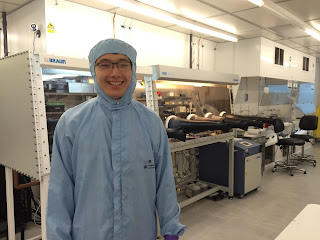
This week started with safety talks, first for the general labs, then for the clean room. I also obtained my amazing blue clean room suit. The first two days were getting used to the inkjet printer, which I printed a protective layer on copper covered plastic in certain designs (starting simple, but getter more complex on Tuesday).  On Tuesday morning, I met Professor John M Shannon, the person who discovered and wrote the first paper on the Source Gated Transistor. On Wednesday, I etched my previously made designs in the copper in the clean room, before attempting to print silver electrodes on glass. I spent the whole day on Thursday in the clean room, preparing substrates, coating them in different substances and using masks, using the JLS Sputterer and other pieces of equipment, as well as making a semiconductor solution. During which, I made metal electrodes on glass, followed by a dielectric and them more metal, putting via holes in some of them, to test Via holes. On Friday I measured the current and resistance of the samples from Thursday, which gave out good results. Afterwards, I attempted to print a semiconductor ink, which failed due to clogging, before reading through numerous papers on Via hole printing so that we can try and improve our process.

Week Three:

This week I started by cutting around 30 glass substrates, for creating source gated transistors on. Before I could do this, I had to clean all the glass by first blowing each substrate with high pressure nitrogen gas, to get rid of any dust particles. Then, I placed them in beakers filled with acetone, and placed the beakers in a agitated water bath for five minutes. Next, I took them out of the water bath and rinsed them with acetone, before blow drying them with nitrogen gas. I then placed them in another beaker filled with isopropanol and then in the agitated water bath for 5 minutes. I rinsed the samples with isopropanol and blow dried with nitrogen gas. Finally, I placed them in a machine that fired high energy oxygen ions at the substrate, finally giving us a atomically clean substrate. Afterwards, I used the JLS sputter machine to place source and drain electrodes on the substrates, using different metals. Then I deposited two different semiconductors, insulator and finally a gate on the substrates. On Friday, I finally got to measure the electrical characteristics of the transistors; even though most had short circuits, the one that worked showed great electronic characteristics. 

Friday, 21 August 2015

What is it like to complete a SATRO Extended Work Placement? Case Study by Toby Peterken

My name is Toby Peterken.  I am currently a student at Esher College.  For my AS year I studied maths, further maths, physics and philosophy and now, for my final year, I am continuing with maths, further maths and physics.   Following my A Levels, I am hoping to complete a degree in either physics or theoretical physics.  I aim to remain in academia - achieving a Ph.D. and then staying on as a research fellow and with any luck becoming a professor of physics. 

I heard about the SATRO placements through an email from college and applied for a placement for several reasons.  Obviously it looks amazing on a UCAS form or a CV, however that wasn’t my motivation.  My main draw to this placement was that it was the first opportunity I have had to make a real contribution.  With year 10 work experience placements or with 1 week summer academies you learn a lot, however you never seem to do any actual work, whereas my work at SSTL (Surrey Satellite Technologies Ltd) did matter – it was the first time this technique had been looked at on land in such significant amounts, so everything I did was new. 

My project was to analyse the data from a satellite to see if there were any correlations between the strength of GNSS (Global Navigation Satellite Systems) reflections and the landforms below and by doing this, see if there were any useful applications of this.  The first 2 weeks were spent mainly programming; I had to create the tools that mapped the data onto Google Earth.  Then we realised that there was too much data and the computer kept crashing, so I had to program another tool that allowed me to load only the data in a certain region.  Then I had to analyse the data, discovering correlation with different landforms below and showing that this technique could potentially be used for mapping deforestation.  I also got to reprogram the timing system for the receiver on the satellite.  


The main skill I learned was programming, this includes more than just learning what a particular line of code does.  I had to learn how to break down large problems into small tasks.  I learned how to go through and debug a program with rigour.  I wrote a program in my first week which, although it worked, was written inefficiently and it just felt messy, so during my last week I rewrote it.  From what I had learned initially, I was able to make the code more elegant and I completed it in much less time. I also understood what other job opportunities were on offer, as I had no idea how much variation there could be with applied physics.    

Wednesday, 12 August 2015

Sam Mansfield - SATROclub Extended Research Placement - KBC

Sam Mansfield of Esher College is currently completed his SATROclub Extended Research Placement at KCB Advanced Technologies, a leading independent oil and gas consulting and technology company. The research project Sam is doing will make use of process simulation to contribute to KBC's innovation program for 2015. The project will be on a refinery unit operation. 

Here's what Sam had to say about his experience so far...

"So far I have created a weathering model that simulates the effect of boil off on the composition of stored LNG and nitrogen injection into exported LNG to maintain wobbe index. It currently supports continuous import and export and adjusts the rate nitrogen injection so that wobbe index of export LNG stays at a constant defined value. It can manually simulate weathering and nitrogen injection for discrete imports and varying continuous exports, however this is a fairly high effor and time consuming process. I need to find a way to pass through values in the time series so that composition and flow rate of accumulation is conserved over each state within the time series without being overwritten by the next state's calculations so it can be done automatically. Neither I nor my supervisor could find an elegant way of allowing this within petro-sim. A meeting with the person who came up with my project idea has been arranged to discuss potential ways of coming up with a more elegant solution to this problem."

Thank you Sam! We wish you the best of luck for the rest of your placement at KCB. 

Wednesday, 5 August 2015

Eloise Knights - SATROclub Extended Research Placement - CGL


Eloise Knights of Tormead School is currently completing her SATROclub Extended Research Placement at CGL (Card Geotechnics Ltd). 

A large site located in Silvertown, London, immediately to the north of the River Thames which is a former industrial estate, including an oil depot, that is to be developed for mixed residential and commercial uses with multiple basements across the footprint. The site is 15ha in area and divided into 3 former wharves. An investigation scope is required to assess the ground related risks to determine the likely impact to construction of the development, both in terms of risk due to contamination and risk relating to stability of the buildings (i.e. foundations and retaining walls). Research is required on the type of ground investigation techniques available, what would be applicable and cost effective and the likely cost of the overall ground investigation. Information is also required to show the Client the importance of ground investigations in the construction industry and how early spending on a detailed ground investigation limits risk and eventually construction costs. Eloise is working with the team at CGL to help conduct this research required. 

Here's what Eloise had to say about her placement so far...

"I began the placement having very little experience of the Engineering discipline which include, Geology and Geotechnical Engineering. Despite my minimal knowledge and understanding, it became apparent that these branches of engineering were more familiar than I had anticipated. Similar to chemical and electrical engineering, Geotechnics involves the analysis and observation of  problems in order to acquire the most appropriate method to resolve the problem. Fortunately, having a mind that enjoys logic and reason, I very quickly understood the processes and engineering methods used by the company to approach the environmental and geological problems. Throughout this week, my appreciation of the significance of what the company does has grown even greater, and likewise my interest."

SATRO wishes Eloise the best of luck for the rest of her placement!

Wednesday, 29 July 2015

Toby Peterken - SATROclub Extended Research Placement - Surrey Satellite Technology Ltd.

Toby Peterken of Esher College is currently completing a SATROclub Extended Work Placement at Surrey Satellite Technology Ltd (SSTL). There is a GNSS Reflectometry Experiment on Tech Demo Sat, and data from this is being downloaded regularly. Toby's project is to post process this data, as guided by the team at SSTL, to try and find relations to geographical features on the ground. This could include streams, ice or other features. The project also involves processing the positioning data and relationship to previous ground testing. Here's what Toby had to say about his experience so far...

Week One

"When I first got here I was shown around the buildings, the different departments, the laboratories and the manufacturing area.

 I was then given a task to be able to make the data easy to visualise. I had to edit a Matlab script so that it automatically generates KML (Google earth) files that display the data from the satellite as coloured paths on the earth’s surface. So that first day was spent trying to learn KML. The second day I started on the Matlab program and got to control parts of the satellite. 

The next two days were spent finishing off/fixing the code. Now it displays signal strength, antenna direction and signal strength compared with antenna direction on Google earth. It automatically loads all the files in each folder and makes the path transparent if the value is too low. I also created a script that draws graphs of other data if needed. 

All of this will be so that it is easy to see if signal strength has correlation with landforms."


Week Two

"As the track data was processed by my program, I was asked to rewrite part of the satellite control program, so that the camera timings were automated. It took 3 days to get it so that the timings didn't clash with other collections and so that it always turned off over the same point over the Earth. It was used to set satellite timings and if it continues to work, could be used permanently.

I then started to look at the data. I realised there was too much information so I created a script to load only information in a particular area and time interval.
 Doing so I was able to look at isolated regions and look for patterns in the data. So far it seems to be sensitive to water."

SATRO wishes Toby the best of luck for the future, and hopes that he enjoys the rest of his placement with SSTL!

Friday, 24 July 2015

Sara Ahmed - SATROclub Extended Research Placement at Jacobs

Sara Ahmed of Rosebery School has just completed her SATROclub Extended Work Placement at Jacobs, an engineering company. Here she has been focussing on Civil Engineering, and completing a project on Building Information Modelling (BIM). We asked Sara to update us on her progress each week, here's what she had to say!...

Week One

"With the first week of my placement coming to an end, I am happy to say that it’s been such an amazing experience so far! Everybody I've encountered at Jacob’s seems only too happy to help me with any queries and I’m really enjoying the experience in Civil Engineering! My report, which seemed absolutely impossible on the first day, is now coming along nicely. I've even managed to fit in some 3D Modelling."

Week Two

"My second week is going just as well as the first!
In addition to having written the majority of my report, I've attended teleconferences and rail meetings as well as doing my own CAD Modelling on Bentley Microstation. I'm loving the experience and find the day going so fast."

Week Three

"As my last week at Jacobs draws to a close, I find myself feeling quite disappointed that I have to go. I've learned an incredible amount about Civil Engineering and the construction industry and everybody here has been so happy to help with my report!"

We wish Sara the best of luck for the future!

Tuesday, 11 November 2014

SATROclub Research Placements - Celebration Event 2014

Students at the 2013 awards evening
Tonight, we are celebrating the recent SATROclub Research Placements. SATRO has participated in the Science Research Projects ever since the programme's inception some 20 years ago, and has afforded this opportunity to over 800 students during that time. Nearly every school with a Sixth Form in Surrey has had a student placement during this time, most have gained the coveted CREST science award and many students have gone on to exhibit and receive acclaim at the annual Big Bang National Science Fair. Students have completed their research in university departments, hospitals, companies and charities, carrying out useful and often very valuable work for their hosts. Each year a number of their projects have been included in publications and this year is no exception, several students will be able to put 'published work' onto their UCAS forms!

The programme in Surrey owes much to the wonderful spirit of participation which the supervisors have brought by providing interesting and appropriate projects for their students. Many supervisors have commented on the enthusiasm and dedication the students have brought to their work, some even saying they would prefer a SATRO student for a month rather than a postgraduate for a year!

Our thanks are due to all our supervisors; our link teachers, who chivvy the students to apply and complete the programme; all the parents and guardians who support their offspring, and of course all the participating students themselves. 

SATRO would like to thank Esher College for being so generous in hosting the Celebration and Induction Events over the time the programme has been running in Surrey. 

Thursday, 18 September 2014

CASE STUDY - WHAT IS IT LIKE TO BE A WEB DEVELOPER?

Mike Arrow is 23 and has worked in Guildford as a web developer since 2012 . He works for Minted Box which is a small company based on the Surrey Research Park in Guildford specialising in web development who work with a wide range of clients ranging from charities to top UK plc’s.

As a web developer Mike takes the designs for websites and turns them into reality for their clients. This sometimes involves working with colleagues to develop a detailed project plan to ensure that all of the pages on the site link together correctly. He learnt some code before he joined the company but has learnt many of the skills that he needs whilst working for the company.

Mike really enjoys his role and seeing the final websites up and running.  He particularly enjoys finding a way of solving problems when the sites are being developed.  Clients may want their websites to be used on a range of equipment and so Mike may need to adapt the coding to ensure that the website works on a variety of devices. One of the biggest challenges he faces is keeping up to date as both the technology and coding is developing very fast.

He thinks that web development suits people who are logical with an eye for detail and who enjoy systematically working through problems to find the solution. He found that doing IT at school and having GCSE Maths together with an understanding of algebra has really helped him as he frequently uses equations when writing code.

His advice to people considering web development as a career should have a go at developing a website for themselves using online tutorials to learn some coding. He used the W3 Schools website: (http://www.w3schools.com/  and suggested that it is worth developing an on line portfolio so that potential employers can see what you have done already. He also suggested that it is also worth asking about work experience to see what it is like to work on web development. 

Tuesday, 9 September 2014

SATRO SCHOLARS AND APPRENTICE AWARDS 2014

Tonight, SATRO is hosting an event at the University of Surrey to celebrate the hard work and achievements of some inspirational young people when we present the annual Surrey Scholars and Apprenticeship awards.  The awards, which will be presented by the High Sheriff, are attended by schools, colleges and businesses from across the Surrey area and celebrate achievements in science, technology, engineering and construction.

Our keynote speaker, Dr Matt Perkins, FREng, CEO of Surrey Satellites Technology Limited (SSTL), will talk about the future of the Space industry in the UK. During his tenure, SSTL has delivered substantial growth and produced possibly the largest cash spinout from a British University, guiding the sale of SSTL to EADS Astrium, the largest space manufacturer in Europe. During the last five years, SSTL's revenues have quadrupled and its staff numbers have doubled. SSTL has secured its two largest contracts including a flagship European programme (Galileo) providing the heart of the new European satellite navigation system and has continued its innovative business approach. SSTL continues to be the world's leading provider of small satellite missions and services. Matt is also the Chair of UKSpace, the trade association for the UK space industry.

Tuesday, 2 September 2014

CASE STUDY - Life as an IT First Line Support Worker

Interested in a career in IT? Have a look at this case study of a IT first line support worker at RAMSAC for advice and information about how to get a job in IT...

What does your company do?
RAMSAC is an IT outsourcing company. They provide a range of IT services for several hundred companies ranging from assisting with
technology projects to providing a helpline to provide IT support for RAMSAC customers.

What did you do before you started working there?
Charles went to school at St Johns in Leatherhead where he gained 11 GCSEs and A levels in ICT, design technology and biology and an AS level in Physics

What attracted you to this job?
Charles decided that he would prefer to get a  job rather than going to University because he didn’t want to get into debt.

He knew that he wanted to work in IT as he had always been interested in it and whilst he was at school he spent his spare time playing with IT and  looking at IT operating systems. He enjoys problem solving and working out how things work together and felt that a career it IT would suit him.  problems.

He spoke to some companies and was concerned that the knowledge that he would gain at University might be out of date by the time that he graduated as the IT industry is developing very quickly. He was also concerned about the debts that he would be left with if he went to University whilst an apprenticeship enabled him to gain experience and qualifications whilst earning a salary.


He found this job after going to an apprenticeship event at Guildford college and taking to a number of companies.

What advice would you give someone thinking about this as a career?
Charles feels that studying for A levels I useful because this helps to develop a work ethic and teaches you how to prioritise and take responsibility for your own work. The actual A levels are less important that an interest in IT  and how systems work although IT A level is helpful (but not essential)

Charles had the following advice for people at school considering their next steps:
·         Before deciding whether to go to University think what type of job you would like to do and talk to people who are recruiting for these roles to see what they are looking for – this could either be employers or recruitment agencies

·         If you are interested in the IT industry remember that it is developing very fast and so an apprenticeship may be a better option than going to University as you will gain the skills that businesses are looking for whilst being paid to do so and without building up a big debt.

Wednesday, 27 August 2014

SATROCLUB EXTENDED PLACEMENTS

Fabia from Strode's College started a SATROClub extended work placement at the University of Surrey on 21st July for 4 weeks. Here's what she had to say about her experience after just a week.

"On the first day we were given a tour of the university followed by journal reading of researches on Vitamin D.
Second day was at Woking town centre with Louise, where we looked for volunteers willing to take a survey on Vit D. At first it was quite difficult given that we had to recruit South Asian volunteers only. Fortunately we were quite successful that day as we got more volunteers than expected.
On the third day, we took a tour to the Surrey Sports Park. There we observed the physical changes like heart rate, oxygen saturation, tidal volume of a person on an exercising bike, the resistance of which increases as time passes. We also had an optional seminar on 'Preventing Brain-Injury Associated with Depression'. Unfortunately I could not attend that seminar since I had blistered my feet that day.

We spent the fourth and fifth day mostly in the office, working on a critical review and the introduction of the report for the Gold Crest Award. The critical review is on a research journal that Louise had set out for each of us. We we'll be presenting our review on the coming Tuesday."

We hope the rest of your placement was as enjoyable and educational as the first week! 

Tuesday, 26 August 2014

SATROClub Extended Work Placement

In July, Thomas from Esher College participated in a SATROClub Extended Placement at the University of Surrey. Here is what he had to say only one week into his placement.

"I found that the first two days were quite intense because my supervisor (Radu) had to teach me a lot of complicated physics. I now understand most of it and it is becoming easier. I have also started using some software to simulate transistors and it didn't take long to get used to it. I am on track to completing my project in 4 weeks. Radu and I created a rough plan for the duration of the project, showing what needs to be done each day, and I am not behind on anything (so far). Although some of the theory involved in the project is very advanced, it is very interesting and I am really enjoying it because I am learning something new and different to what I have learned in college. Radu is a great supervisor. He is very helpful and a good teacher. He is also very friendly and I enjoy going to lunch with him and Will, who is working on a similar project with Radu."

We hope the rest of your placement was just as enjoyable as the first week, Thomas!

Tuesday, 19 August 2014

SATROCLUB EXTENDED WORK PLACEMENT

Atdhe is on an extended work placement at Jacobs, an engineering company. Here is what he had to say about his experience so far...

"I'm already finding the placement positively challenging and intriguing, I have been given 3 possible situations that I could choose to work on: The first being some restructuring work at Sydney Harbour Bridge; the second was the replacement of the deck at Church Bridge in Gloucester; and the final option was work on Carter Bridge in St. Helens. I spent the first couple of days making myself aware of the context behind each bridge, reading various reports and analysing complex drawings. Towards the end of the week we decided to exclusively look at the Church and Carter Bridge's further. On Friday I spent many hours working out various dimensions and researching material densities in order to determine the impact of each option on the environment with respect to their carbon footprints. A major surprise to me is in how relevant my work is and the responsibility and freedom that I have been given in carrying out my work, in such a manner that I have never experienced prior to this week."

We hope you enjoy the next three weeks of your placement, Atdhe! 

Tuesday, 12 August 2014

SATROCLUB EXTENDED WORK PLACEMENT

Student Thomas Burridge started his placement at the University of Surrey on 14th July, where he would be working for 4 weeks. Here is what he had to say about his experience after 2 weeks..

"I am now 2 weeks into my placement (started on 14th July). I found that the first two days were quite intense because my supervisor (Radu) had to teach me a lot of complicated physics but I now understand most of it and it is becoming easier. Although some of the theory involved in the project is very advanced, I am really enjoying it because I am learning something new and different to what I have learned in college.
My project is based on simulating transistors so I have learned how to use some software to simulate the transistors and it didn't take long to get used to it. We spent three days making transistors in the lab and then testing them, which I thought was very interesting. Overall I have had a great experience so far and I am looking forward to the next 2 weeks of my placement."

We hope you enjoyed the final 2 weeks of your placement Thomas!

Monday, 11 August 2014

SATROClub Extended Work Placement

Student Sagar Jaiswal from Strode's College has been involved in a SATROClub Extended Work Placement over the past few weeks at Technotomy, a specialist software development business. Here is what he had to say about his experience after only just a few days in...

"Having started my placement in Technotomy just a few days ago I have already learnt so many things. From overcoming complex problems to the art of coffee making, Technotomy has involved me at every step.

So far, this placement has provided me with a chance to learn new programming skills that will prove vital for my chosen degree at University. It has also given me an opportunity to implement and enhance my programming skills already learnt.

It has given me a chance to be independent on a big project and helped me to realise my true potential. In this placement, everyday is different where I have not found a task challenging. This further motivates me to complete the task with in stipulated deadline. This is one of the main reasons for me to look forward to the placement.


Lastly, it proves to portray itself like a job and provides me the taste of how it would be to work in a real company. All in all I am having a very good experience."

Friday, 8 August 2014

THE SCIENCE BEHIND THE DIMPLES OF A GOLF BALL

With the PGA Championships beginning today, we thought it would be topical to have a blog about a bit of the science behind golf! So here goes the science behind the dimples in a golf ball… About a century ago, golfers began to realise that a scuffed-up ball with dents and dimples from long use, travels further than a smooth new ball, so, golf balls gained dimples. Gold ball manufacturers now invest millions each year to design the best performing golf balls. The dimples in gold balls create turbulence, or ‘mixed air flow’ which, if designed correctly, reduces drag on the ball. There are two main types of airflow – laminar and turbulent. Laminar movement creates less drag but it is susceptible to ‘separation’ – where the air layer that ‘clings’ to the ball as it moves to the air separates from the ball. Turbulent flow creates more drag initially, but is less vulnerable to separation. At high speeds, like that of a golf ball, you will want this air layer to cling to the ball as possible, and the dimples in the ball allow this to happen!